Six-Axis Kinematics & Light-Painting

Parametric Robotic
Light-Path Control

This project explores the translation of complex vector graphics into precise robotic motion through algorithmic deconstruction. Utilizing a Kuka KR-10 six-axis robot, the workflow converts static digital branding into a light-painting installation, bridging the gap between graphic identity and physical kinetic art.


Technical Methodology

Pathing Logic
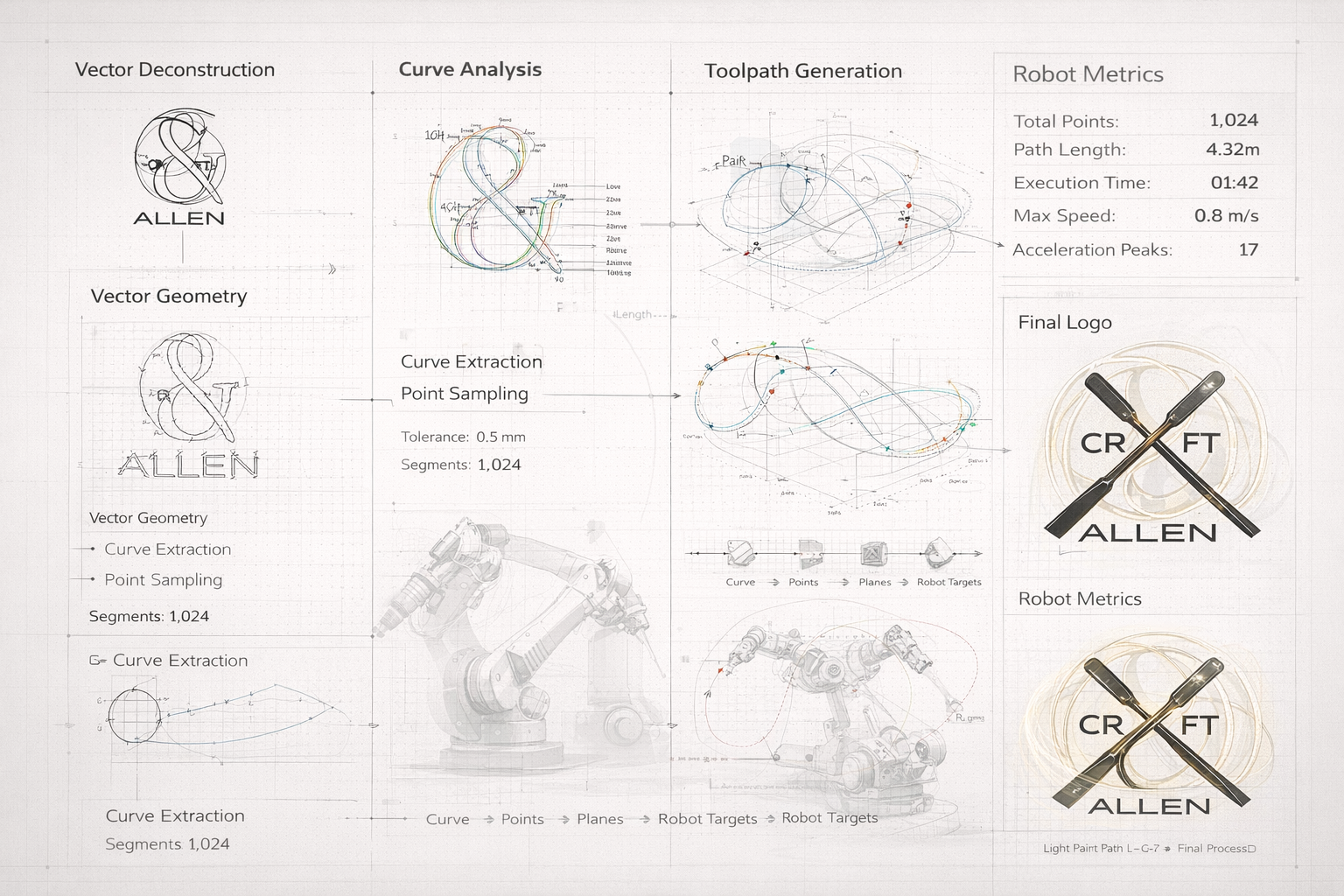
Source geometry exploded into a point cloud of over 1,000 discrete coordinates (X, Y, Z) via custom Grasshopper scripts.
Tooling
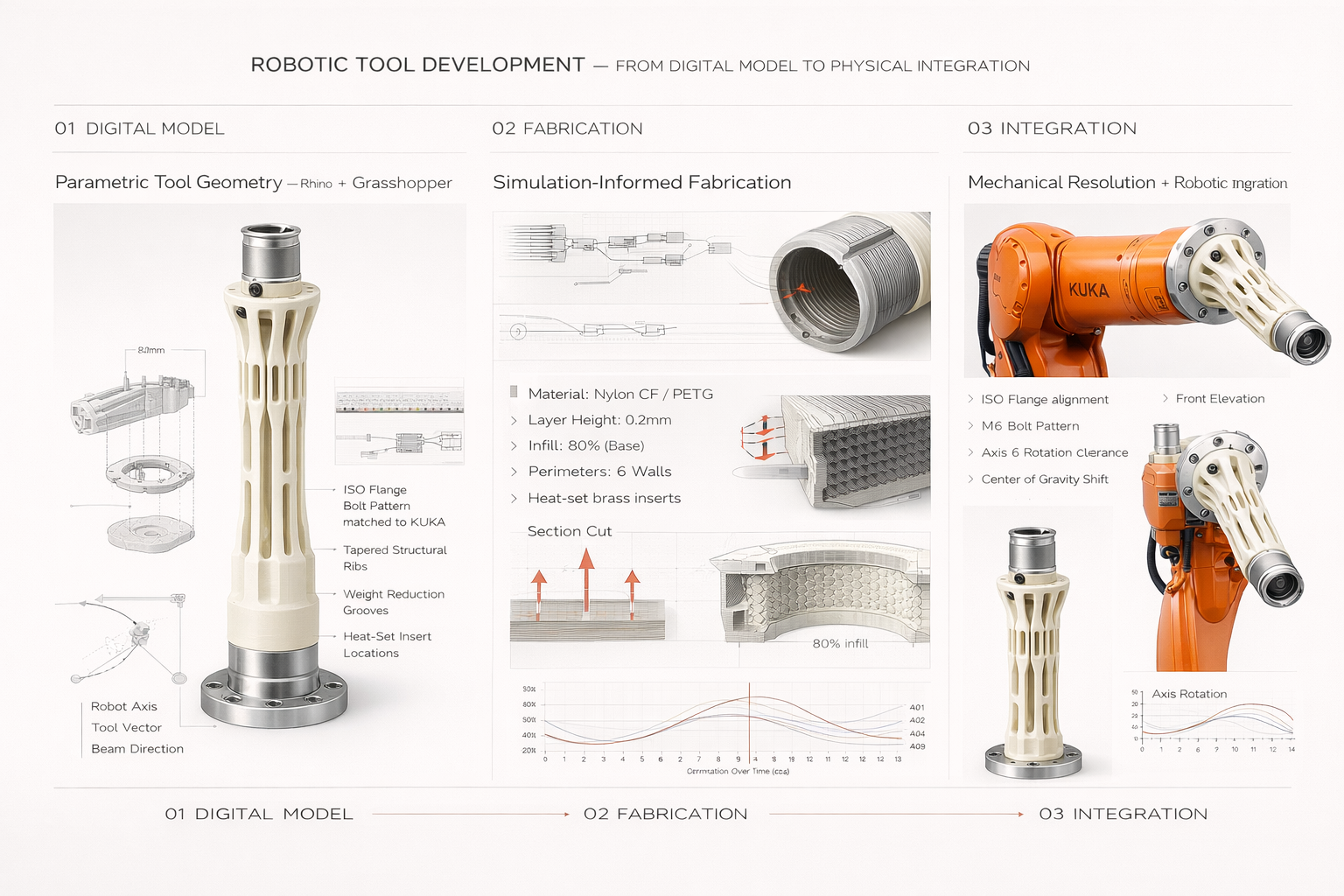
Custom 3D-printed end-effector featuring a tapered internal geometry and M5 threaded interface for high-precision flange alignment.
Kinematic Execution

Robotic Light-Path Control

Course / Year
ARCH A172 / 2016
Hardware
Kuka KR-10 (6-Axis)
Software Stack
Grasshopper / Kuka|prc
Process
Algorithmic Point-Cloud

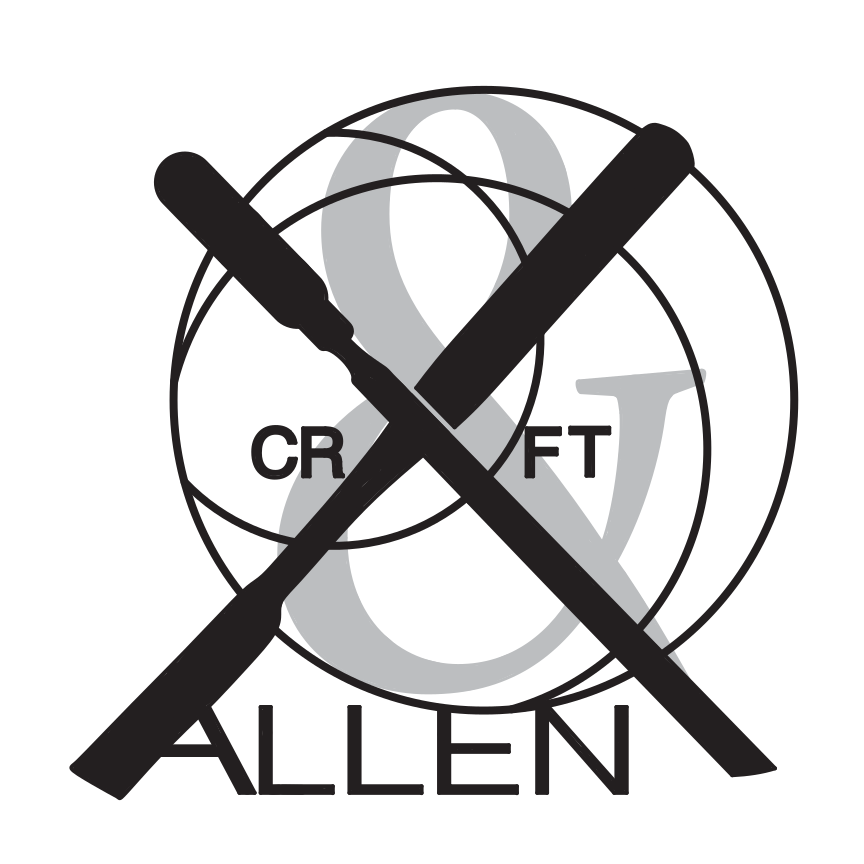
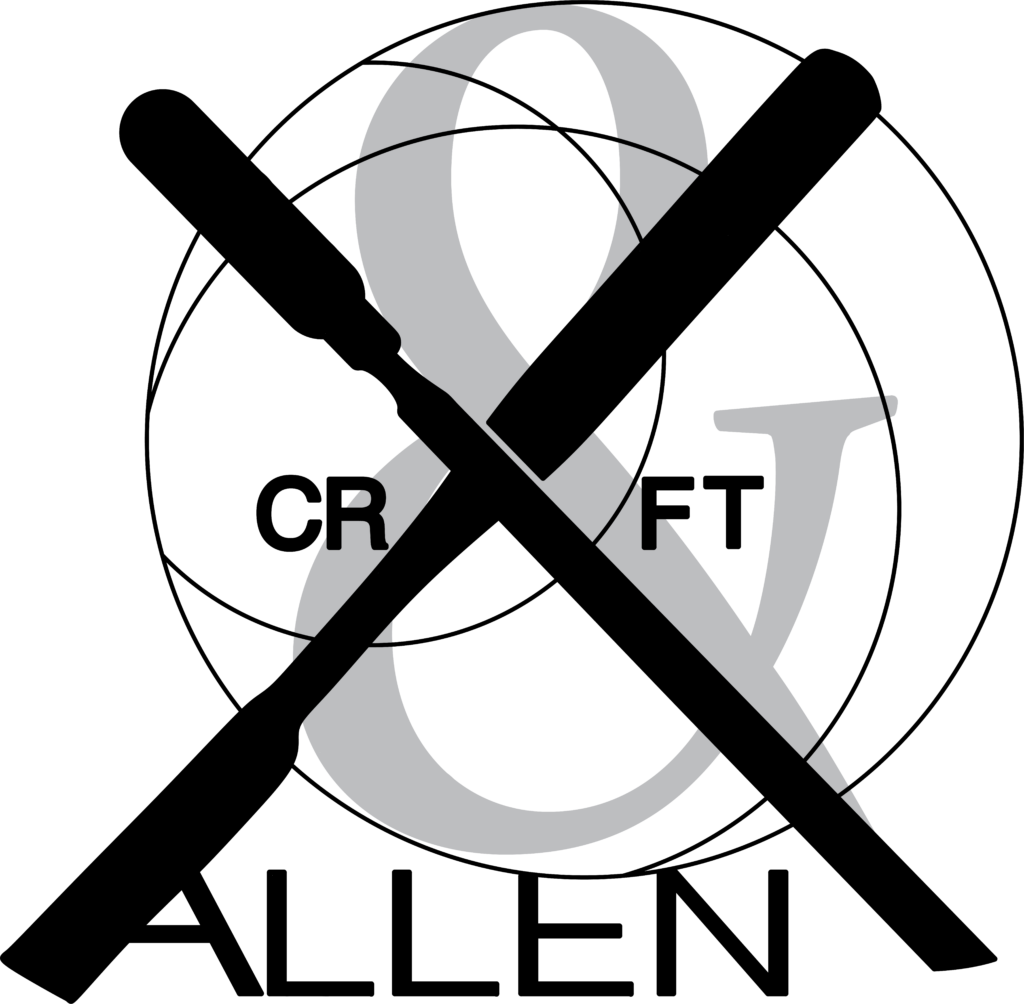
Reference Logo

This is the original Craft & Allen vector logo used as the source geometry for the robotic point-cloud generation.

Phase 01

Vector
Deconstruction

The workflow began by exploding static vector geometry into a continuous single-line segment. Using a custom Grasshopper script, the logo was “shattered” into a point cloud of over 1,000 discrete coordinates, forming the mathematical DNA of the robotic path.

Technical Stack

  • Environment: Rhino 3D
  • Algorithmic: Grasshopper
  • Geometry: Vector / Point-Cloud

Phase 02

Kinematic
Programming

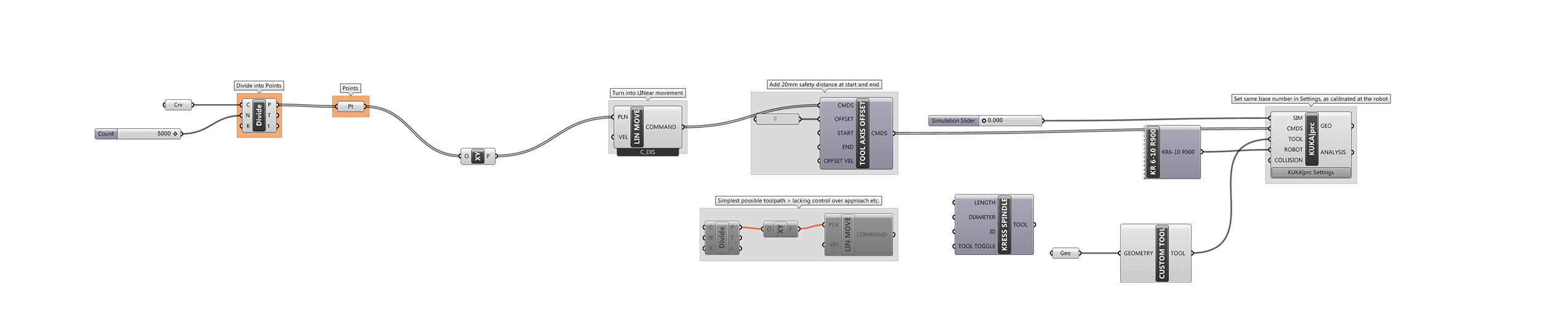
Using Kuka|prc, the coordinates were mapped to the robot’s kinematic workspace. This stage involved simulating joint reachability and programming high-fidelity tool-paths with a 20mm safety offset to ensure fluid, collision-free motion during the light-painting process.

Technical Stack

  • Kinematics: Kuka|prc
  • Sim: Real-time Reachability
  • Control: Custom G-Code

Phase 03

Kinematic
& Capture

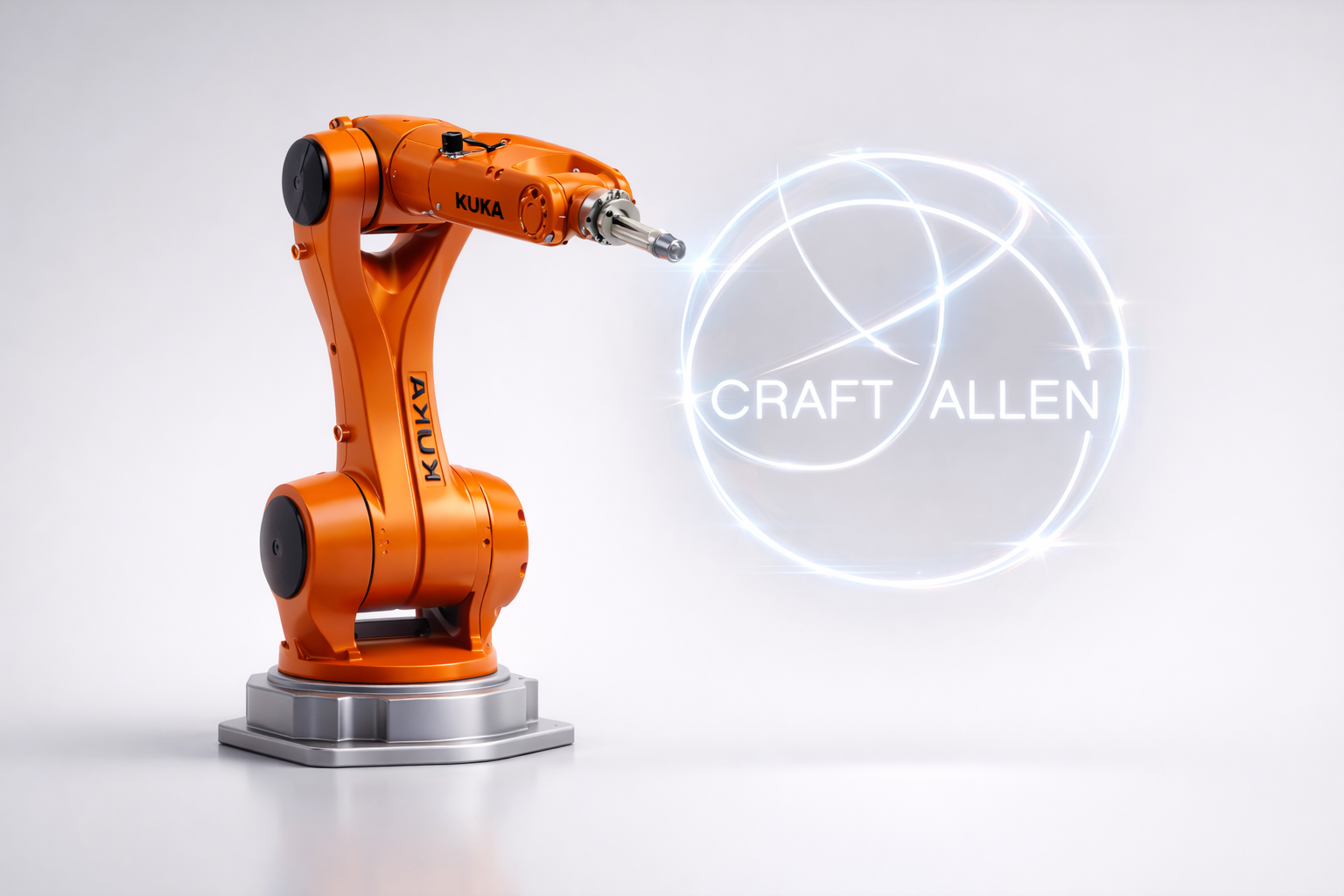
The final execution translated digital paths into long-exposure light traces. By mounting a custom LED end-effector to the Kuka KR-10, we captured the robot’s kinetic agency through a high-fidelity camera lens. This process successfully synthesized motion into a singular, temporal image, proving the precision of the programmed logic in physical space.

Technical Stack

  • Capture: Long-Exposure Photo
  • Tooling: Custom LED End-Effector
  • Motion: 6-Axis Kinematics
  • Control: Kuka|prc Pathing

Phase 02

Kinematic
Programming

Using Kuka|prc, the coordinates were mapped to the robot’s kinematic workspace. This stage involved simulating joint reachability and programming high-fidelity tool-paths with a 20mm safety offset to ensure fluid, collision-free motion during the light-painting process.

Technical Stack

  • Kinematics: Kuka|prc
  • Sim: Real-time Reachability
  • Control: Custom G-Code

Outcome

Synthesis of
Motion

The culmination of this project is a compression of time and geometry. By visiting each of the 1,000+ coordinates in a precise sequence, the Kuka KR-10 transforms a static 2D identity into a 3D spatial experience. The lack of jitter in the light trails serves as a proof of concept for robotic architectural drawing and high-fidelity kinematic execution.

Final Synthesis

  • Logic: Digital Agency
  • Trace: Temporal Art
  • Result: Spatial 3D Logo

Synthesis of Motion

This project serves as a proof of concept for robotic architectural drawing. By merging parametric design in Rhino with the physical precision of the Kuka KR-10, we transform a static 2D identity into a 3D spatial experience.

The final light-trace is not just a logo, but a record of a thousand calculated decisions executed in perfect synchronization.

Digital Logic • Robotic Agency • Temporal Art

Project Inquiries

Get in Touch

Southern California — Available for select commissions.

Rise|Shelf

Product Design | A modular furniture system engineered for scalability, combining flat-pack logistical efficiency with the tactile weight of solid-wood craftsmanship.

MacBook Pro Sleeve

Product Design | A masterclass in functional minimalism, the MacBook Pro Sleeve is precision-crafted from European leather to safeguard your device without compromising its iconic silhouette. Featuring an integrated 18-degree folding stand and a secure clamshell fit, it is designed for the modern nomad who demands both protection and performance.

Elevate – Dock

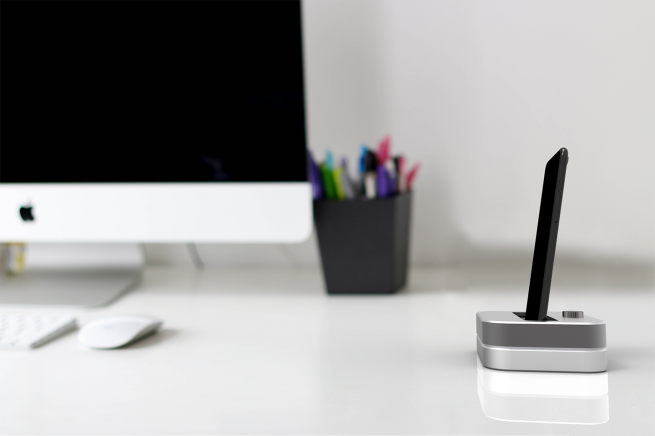
Product Design | Precision-engineered for functional minimalism, the Elevate Dock features a weighted stainless steel core and an 18-degree ergonomic tilt. Designed for zero-tool assembly, its adaptive internal geometry provides universal compatibility for any smartphone and cable, creating a seamless, clutter-free environment for your workspace.

Adaptable Dock

Product Design | Precision-engineered for functional minimalism, the Elevate Dock features a weighted stainless steel core and an 18-degree ergonomic tilt. Designed for zero-tool assembly, its adaptive internal geometry provides universal compatibility for any smartphone and cable, creating a seamless, clutter-free environment for your workspace.

Portfolio and Watch Dock Case

Product Design | A study in material contrast and precision joinery. This custom walnut housing utilizes a hybrid fabrication workflow—pairing 3-axis CNC machining with 3D-printed porcelain to create a high-fidelity tactile experience and a seamless, friction-fit integration of components.

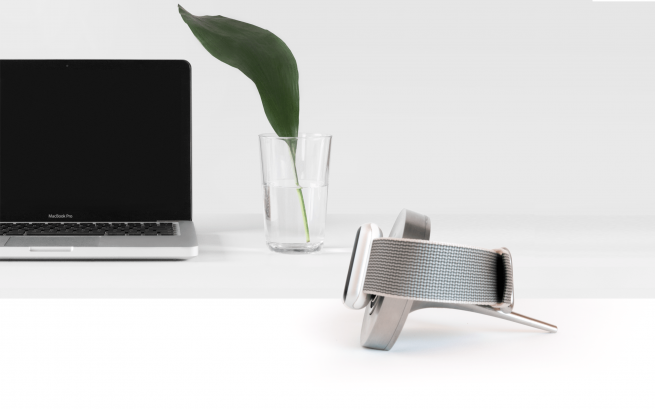
Apple Watch Dock

Product Design | A study in kinetic elegance and tactile precision. Inspired by the silhouette of a spinning top, this dock utilizes a solid 316L stainless steel core and a hidden ball-plunger system to provide a secure, click-into-place housing for interchangeable shells—transforming the Apple Watch into a sculptural bedside centerpiece.